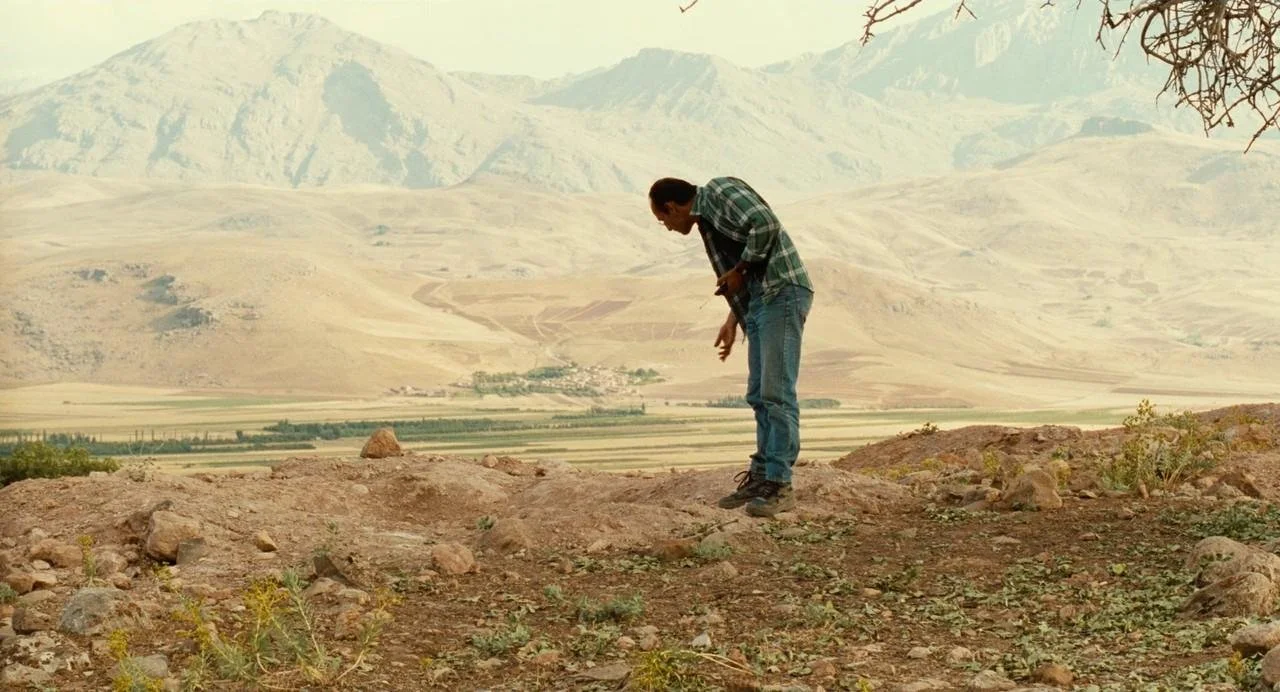
Behzad, in ‘The Wind Will Carry Us’, talks to the man digging underground
One evening in the mid-1990s I found myself in a Dublin video shop, borrowing some tapes. In the course of conversation with the knowledgeable assistant, I was recommended Abbas Kiarostami’s ‘Close-Up’, a film I had heard of, as it had won a prize at Cannes, but about which I knew little. The following week I watched it and found the film both puzzling and enjoyable. ‘Close-Up’ is neither a documentary nor fiction; it is not a courtroom drama, an unusual human interest story, nor a reflexive essay on the nature of cinema, although it contains characteristics of all of these genres. As one writer has observed, it is a film about the difference between who you are and who you believe you deserve to be, made by a director who understood that the way to explore that difference is to blur, or even to dissolve, boundaries. ‘This is cinema at its most radical’, the article concludes, ‘not because of what it shows, but because of what it refuses to resolve. ‘Close-Up’ asks whether a man who lied about being an artist was, in the act of lying, doing something artistic. It does not answer. That refusal is the answer’.
I sought out Kiarostami’s other films, which were not easy to find. The ones I watched were those in the so-called ‘Koker Trilogy’, which comprises ‘Where Is the Friend’s House?’ (1987), ‘And Life Goes On’ (1992), and ‘Through the Olive Trees’ (1994), all of them set in a village in the northern part of Iran and portraying life before and after the massive 1990 earthquake in the area. Gentle but sharp, they are meditations on rural lives and landscapes; they have something of the character of parables and pose as many questions as they answer. They’re about cherishing the world and its people, things, and events, even when we don’t fully comprehend them.
In the more complex and despairing ‘Taste of Cherry’, which followed in 1997, Badii, a middle-aged man, drives around Tehran looking for someone to do a job for him, for which he offers a substantial sum of money. During his conversations with possible collaborators, Badii explains that he plans to die and that he has already dug his grave; he wants someone to go there in the morning and help him out if he is alive, or bury him if he is dead. He doesn’t clarify the reasons for his gloom. The story, dialogue, and ending are all ambiguous in Kiarostami’s particular way, but the final sequence is especially equivocal; on the verge of revelation, it pulls back at the last moment, and in doing so, shifts the audience's grasp of the film. Interestingly, there were two different versions of the film at the time; one that had the full final sequence and another without it.
All of this came back to me after rewatching ‘The Wind Will Carry Us’ (1999), one of Kiarostami’s most accomplished and entertaining works. It concerns a Tehrani journalist, Behzad, who arrives in a remote Kurdish village in Iran with a crew, all posing as engineers; they’ve come to wait for the death of an elderly woman, hoping to document the traditional self-mutilation mourning rituals that they expect will take place in the village afterwards. The woman lives on, obliging the impatient journalist to extend his stay. Behzad’s urban needs and habits conflict with the rhythms and realities of rural life; he struggles, for instance, with poor phone reception, which requires him to drive regularly to a hilltop graveyard, where he has strange encounters and conversations with unseen locals. As the days go by, however, Behzad gradually becomes more involved in village life, creating unexpected connections and developing a new perspective on life, death, and the enduring spirit of the community.
Throughout the film, as though reflecting Behzad’s unwillingness to discard or transcend his customary views of the world, he interacts with people whom we don’t see. He talks on the phone to someone important, but we are not sure who it is, and to his assistants, whom we hear but are never in shot. The old woman whose death ceremonies they have come to film is constantly referred to, but she is never visible. A man digging underground in the graveyard speaks but is not revealed; a young woman who is milking a cow in a cellar is enveloped in shadow with her back turned to the camera. By the end, though, Behzad is learning to see afresh. In a sequence that echoes scenes in both ‘Close-Up’ and ‘Taste of Cherry’, the local doctor gives him a lift through golden wheat fields on the back of a motorbike; quoting Omar Khayyam, he declares that the earth is full of beauty and wonder, despite the presence of death. Can the next world really be better than this?
As I reflected on the ending, it brought to mind Glowrushes, the celebrated Italian children’s book by Roberto Piumini, a story about a distinguished painter named Sakumat who makes his way from the Turkish city of Malatya to a distant land ruled by Lord Ganuan, who has commissioned him to paint the windowless rooms of his son, Madurer, a sickly child whose incurable illness means that he can have no contact at all with nature. His assignment is to decorate the rooms that Madurer can never leave, but it turns into something much more profound. Sakumat listens to Madurer’s words, observes his life, and assesses his wishes before beginning to paint. His intentions are clear; the murals in Madurer’s rooms will be not only for him, but by him; the painter will be guided by the boy’s soul and imagination. It is Madurer who conceives of the ‘glowrushes’, describing them as rare ‘firefly-plants’ that light up the fields when it is dark; one night soon afterwards, he is woken by Sakumat and told to look at the painted walls: ‘Bewildered, the boy sat up in bed. All around him in the darkness, hundreds of slender wisps glowed with a golden light. Bending this way and that, they shone throughout the dark meadow and seemed to sway in the wind’. The fable tells us that art and beauty can be deeply transformative, even in the face of sorrow and tragedy.
For further exploration
‘Close-Up’ trailer: https://www.youtube.com/watch?v=YeFZ448yQ-0
A good article on ‘Close-Up’: https://deepfilmanalysis.com/close-up-1990-deep-film-analysis/
‘Taste of Cherry’ trailer: https://www.youtube.com/watch?v=ukmYdGwVqPg
‘The Wind Will Carry Us’ trailer: https://www.youtube.com/watch?v=xq1gXC3119A
On Glowrushes: https://glli-us.org/2024/10/16/italianlitmonth-n-28-glowrushes-by-roberto-piumini-a-timeless-italian-masterpiece/
Image on index page: still from ‘The Wind Will Carry Us’
A 17th century miniature Mughal painting of a young prince