Older now, and lost again
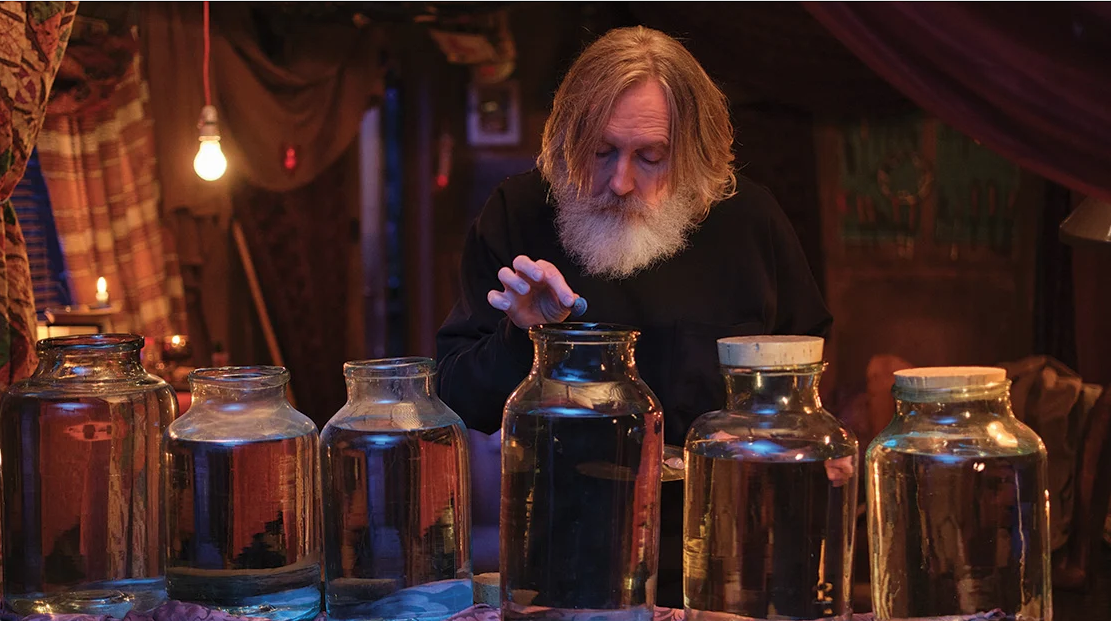
Still from ‘Small Prophets’
In contrast to the rural Essex of his wonderful ‘Detectorists’, Mackenzie Crook’s new television series, ‘Small Prophets’, is set in suburban Greater Manchester. Michael Sleep, played flawlessly by Pearce Quigley, is long-haired and bearded; he lives in a cul-de-sac of semi-detached houses, and Clive, a next-door neighbour, is deeply irritated by his overgrown home and its unkempt driveway. Inside are stacks of cardboard boxes belonging to Clea, his partner, who disappeared mysteriously almost seven years before; the living-room, now locked, is an uncanny recreation, based on a photograph, of her best-ever Christmas. Michael works at a big DIY store, where he mooches around, gives bad advice, and makes bitter comments, while occasionally demonstrating great warmth and generosity. His bossy and ineffectual manager, Gordon, played by Crook, is a skinny man with a spindly ponytail down to his waist and aviator glasses; he despairs of Michael, who uses the slightest pretext to leave work and visit his father in a rest home, but he doesn’t quite have the determination to fire him.
The story soon veers off on a tangent, and Michael’s main preoccupation becomes the cultivation of homunculi, small human-like beings, in large glass jars, following an ancient formula his father learnt in Egypt during his time in the army and has advised him to pursue. These bizarre creatures, the ‘Small Prophets’, briefly develop the power of divination and are incapable of not telling the truth if they are grown correctly, and Michael wants to discover what happened to his beloved partner. Meanwhile, he begins to develop an unlikely friendship with a young colleague, Kacey, played by Lauren Patel, whose curiosity, frankness, and good nature enable her to tolerate and even enjoy the older man’s waywardness and sharp tongue. Their connection is platonic, based on mutual support that has nothing to do with romance but is nonetheless intimate. Michael’s relationship with his father, played by Michael Palin, is similarly warm and benign; he is unendingly sensitive to Brian’s faltering memory and precarious balance between normality and off-beat eccentricity.
Crook has explained that the idea of growing homunculi was derived from reading about Paracelsus, the 16th century physician, alchemist and philosopher, who sought to combine empirical observations with spiritual insight. In the medieval and early modern periods, boundaries between science, mysticism, and religion were fluid and permeable, and this was reflected in Paracelsus’ series of treatises, De Natura Rerum (‘Of the Nature of Things’), in which there is an intriguing and controversial passage about a procedure that he claims will create an ‘artificial man’, or homunculus. Despite its marginal position in Paracelsus’ work and the scepticism it attracted among his later followers, the notion turned out to be surprisingly influential; it inspired Goethe, whose Faust, Part II includes a homunculus, a symbol of the inadequacy of purely intellectual interests, as well as Mary Shelley’s Frankenstein, in which artificial life and the consequences of human hubris are central themes.
Later, in a psychoanalytic context, Carl Jung interpreted the homunculus as a symbolic expression of inner change, linking it to the filius philosophorum — the spiritual child born of the alchemical union of opposites. The homunculus became not only a historical curiosity but a pungent metaphor for creation, transformation, and transgression. Jung’s interest in early wisdom traditions, including Gnosticism, led to a fascination with alchemy; they were all deeply concerned with the soul’s journey and a quest for direct spiritual knowledge. He found in their thinking much that aligned with his own theories; notions about transformation, the opposition of light and darkness, and the divine spark in matter were reflected in psychological patterns and processes he observed in his patients’ dreams and fantasies. As Jung developed his concept of the ‘collective unconscious’, he noticed parallels between what he called ‘archetypal’ motifs and the symbols in Gnostic and alchemical traditions; he came to believe that they could be used to describe the ‘individuation’ process and to provide a structure for it. In short, Jung regarded alchemical experiments and experiences as manifestations of a transformative process that involved the dissolution and reintegration of elements of the psyche.
All this, of course, is far from the nub of ‘Small Prophets’, although it could be said that Michael (whose surname may not be coincidental) is also searching for recovery, transformation, and renewal. The tone of the programme is gently self-mocking and sometimes sharp; there are occasional references, for instance, to the resemblance of the homunculi to ‘Sea Monkeys’, the bizarre children’s fad of the 1960s and 1970s. While it touches on some of the dehumanising effects of contemporary life and contains plenty of absurdist moments, the tale is a warning about the deadening aspect of nostalgia; Michael, who has emotionally locked himself away after Clea’s disappearance, becomes more spirited as he opens up to the present, creating the homunculi not out of interest in alchemy or magic but because he needs answers that conventional knowledge has failed to provide. The plot sags somewhat in the middle episodes but quickly recovers its momentum, helped by keen dialogue and tart wit; quiet despair and loneliness, which also add an edge, lie just below the surface. The soundtrack by Cinder Well, which includes the evocative ‘The Wise Man’s Song’ (from which the title of this essay is taken), is melancholic and a little weird, as are most of the characters, even minor ones like Brigham, with his insane laughter, the young Eliot, who likes cycling in circles around the cul-de-sac wearing a hoody, and the threatening but sentimental mugger. There is to be a second series, and it remains to be seen what will be revealed, but as one reviewer has remarked, if ‘Small Prophets’ contains a message or a moral, it is surely that there is still wonder, affection, and humour to be found in a world that often seems to be singularly lacking them.
For further exploration:
Review of ‘Small Prophets’: https://www.theguardian.com/tv-and-radio/2026/feb/09/small-prophets-review-mackenzie-crooks-magical-new-comedy-is-pure-pure-pleasure
‘The Wise Man’s Song’: https://www.youtube.com/watch?v=aMozPZ7-GzA
Paracelsus: https://brewminate.com/fabricating-the-artificial-man-paracelsus-and-homunculus-in-de-natura-rerum-1537/
Jung and alchemy: https://thisjungianlife.com/jungian-alchemy-the-secret-of-inner-transformation/
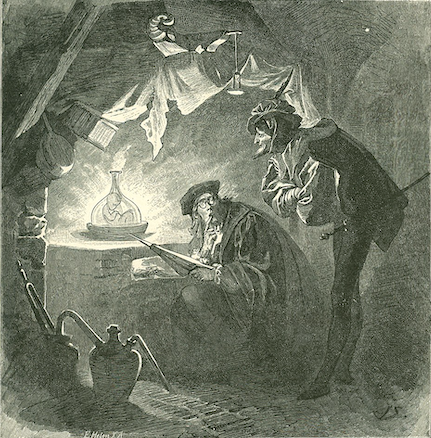
An illustration from Goethe’s ‘Faust, Part II’