Ragged-trouser philanthropists, moral economists, and Irish ‘sessions’
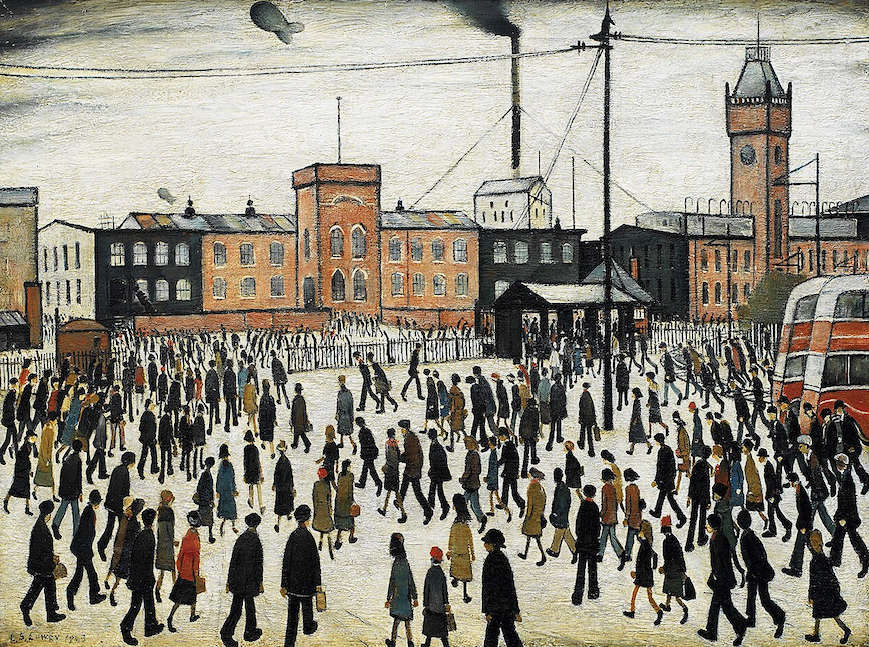
‘Going to Work’ by L.S.Lowry, 1943
The Ragged-Trousered Philanthropists, first published in 1914 under a pen name, is a semi-autobiographical novel about the exploitation of the English working classes; long, passionate, and occasionally entertaining, it was written in his spare time by Robert Noonan, an Irish house painter and decorator. The story describes his desperate attempts to find work and avoid poverty in an English town; the original title page, drawn by the author, had the subtitle ‘Being the story of twelve months in Hell, told by one of the damned, and written down by Robert Tressell’.
Noonan, the son of Mary Ann Noonan and Samuel Croker, a retired magistrate, was born in 1870 in Dublin’s Wexford Street, where there is now a plaque celebrating the event; he settled in England in 1901 after some time living and working in South Africa. Choosing the alias ‘Tressell’ as a reference to the table, an essential tool of his trade, he based the book on personal experiences of hardship and the fear that he and his daughter, Kathleen — whom he was raising alone — would be consigned to the workhouse if he fell ill. Much of it comprises a detailed and fierce analysis of the relationship between working-class people and their employers; the ‘philanthropists’ of the title are the former, who, in the author’s view, acquiesce in their own oppression. Influenced by the ideas of the socialist campaigner Robert Blatchford and William Morris, the book is set in the fictional Mugsborough, which was inspired by the southern English coastal town of Hastings, where Noonan lived. The protagonist is Frank Owen, a journeyman painter and self-proclaimed prophet of socialism, who challenges the accepted opinions of his peers with stirring speeches about the greed and ruthlessness of capitalist employers. His spirited disquisitions are intended to rouse the social consciousness of his fellow-workers, but they generally remain uninterested; his relentless quest becomes increasingly futile and ends in despair. The Ragged-Trousered Philanthropists was finished in 1910, but the 1,600 hand-written pages were apparently rejected by the three publishing houses to which they were submitted, and this caused Noonan to fall into deep depression; his daughter had to save the manuscript from being burnt by keeping it in a metal box under her bed. In due course, however, the book was widely read and became much admired, especially by English socialists.
Noonan believed that the fundamental flaw in capitalism, as is often assumed today, is material and economic inequality. Although this might have been true then, and may still be so, opinions of other left-wing thinkers in England have often differed; while disapproving of economic inequity, some were were equally critical of the utilitarianism and acquisitiveness that thrive in capitalist conditions. The most notable were R.H.Tawney, Karl Polanyi, and E.P.Thompson, all of whom offered a moral and communitarian way of approaching political questions such as equality, freedom, and solidarity. Exploring the relationships between economics and ethics, their theories rejected both laissez-faire systems and authoritarian control. Aspiring to forms of social solidarity that were tighter than those of individualism but looser than the ideals of collectivism, Thompson developed that perspective in a 1971 essay, ‘The Moral Economy of the English Crowd in the Eighteenth Century’, where he referred to a specific class struggle in a particular era, seen from the point of view of the poor rather than that of investors and business owners. Explaining why the populace made the decision to take to the streets in food riots, he concluded that they were grieving the loss of their traditional livelihoods and ways of life, as well as facing the threat of penury.
Recently, as I passed by Whelan’s, the well-known pub and music venue in Wexford Street, and remembering that Robert Noonan was born nearby, it also occurred to me that a thriving example of cultural ‘moral economy’ can be found in an Irish traditional music session, or seisiún, where there is commonly a kind of social solidarity characterised by sharing and participation. It is interesting that the history of such gatherings is not as deep-rooted as many might believe; the first recognisable ‘session’ took place in the 1940s in London’s Kentish Town. Music groups were not allowed in pubs until after World War II, either in Ireland or Britain, but this began to change when thousands of Irish people crossed the sea to rebuild England and to work in the emergent National Health Service. Many of the immigrants missed playing and listening to traditional music, and in 1946 the Irish landlord of the Devonshire Arms invited a few compatriots to bring along their instruments and enjoy themselves. Mainly from a small area around Tubbercurry in Co.Sligo, most of them knew each other or their relatives, and they would have been used to experiencing music in private kitchens, village halls, or outdoors; now, however, they were playing and listening in a public house. The first modern ‘sessions’ were taking shape.
Currently found all over the world, Irish ‘sessions’ attract a substantial number of loyal followers, some of whom just want to listen, while others prefer to join in. Appropriate forms of behaviour on these occasions have been informally but firmly defined; novices and vistors who wish to participate are encouraged to introduce themselves, ask permission to take part, and not to play if they don’t know the tunes. They are expected to be patient, to await their turn, and not to push in or interrupt the set. It is the prerogative of the person who starts a tune to choose the next one, and as one online forum advises, it’s wise to ‘keep an eye and an ear out for their signal that the change is coming up, but don’t try to barge in with one of your own, and never play too loudly. Don’t comment on anyone else’s tuning or playing, but don’t be offended if someone shares their opinions on yours’. Rules for listeners are simpler: don’t occupy a seat without asking if it’s already taken, don’t leave your pint on the floor, and don’t clap along with the music.
It is possible that this ‘moral economy’, a combination of respect for other people, sharing, and intimacy, accounts for a great deal of the attraction of the Irish seisiún, perhaps almost as much as that of the music itself. In 2021, one of its main homes, the Cobblestone pub in the north side of Dublin, came under threat of closure when development plans for the area were announced. There were widespread popular protests, and an online petition gathered 35,000 signatures. The rebellion was successful, and the Cobblestone continues to flourish.
For further exploration:
The Ragged Trouser Philanthropists (an interesting analysis): http://unionhistory.info/ragged/ragged.php
A review of Tim Rogan’s The Moral Economists: https://eh.net/book_reviews/the-moral-economists-r-h-tawney-karl-polanyi-e-p-thompson-and-the-critique-of-capitalism/
The Cobblestone: https://www.cobblestonepub.ie/
Image on index page: painters and decorators in England, early 20th century
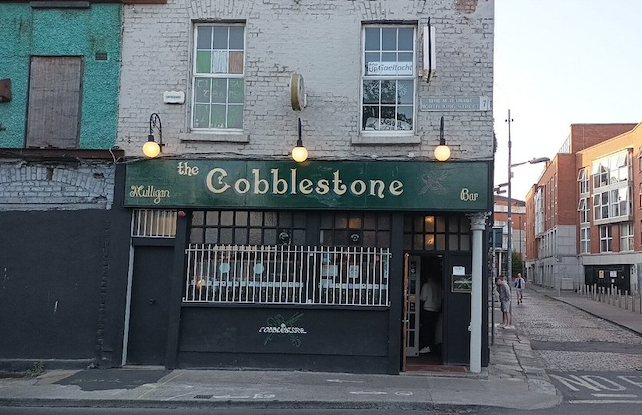
The Cobblestone, Dublin