Morandi’s Objects
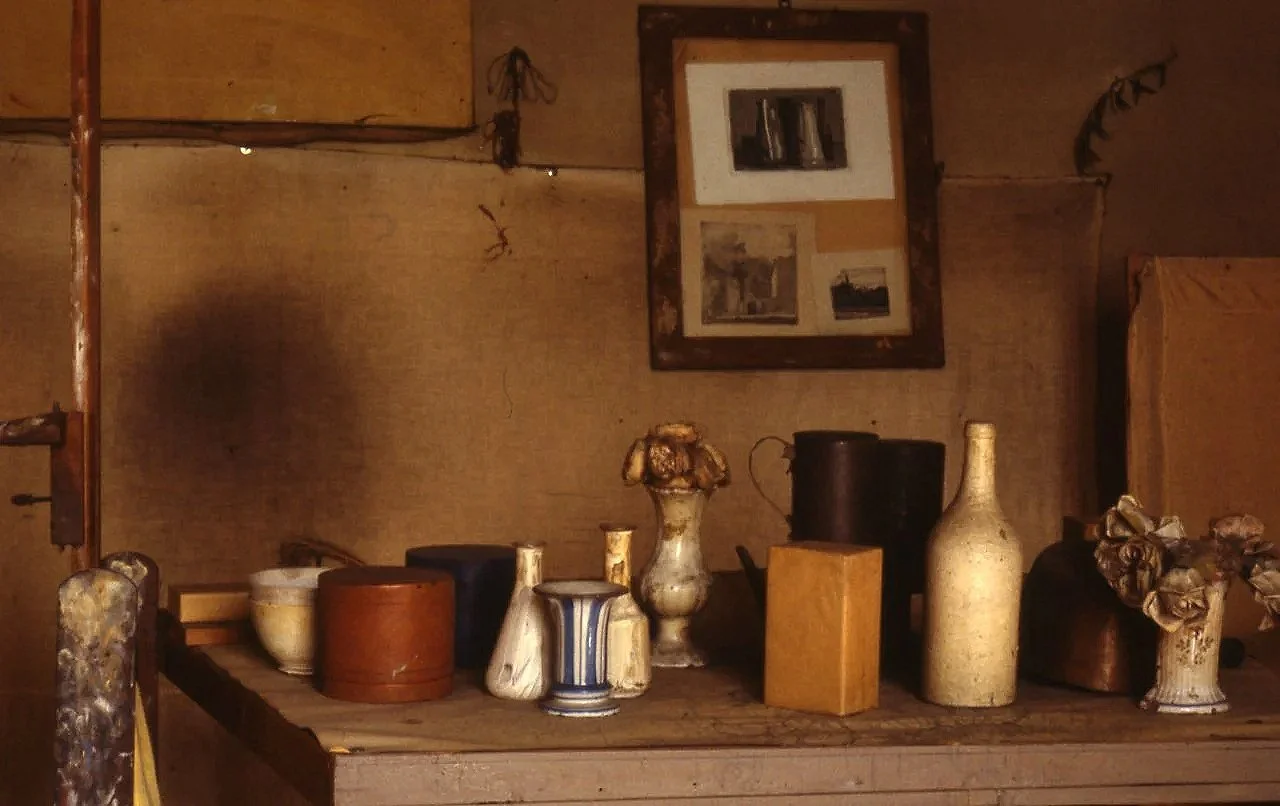
Giorgio Morandi’s studio (photo by Paolo Monti)
For a quarter of a century, the tall and shy Giorgio Morandi taught drawing, engraving and etching at Bologna’s accademia, which was within walking distance of the home he shared with his mother and three unmarried sisters. A reluctant traveller, he left Italy only twice, both towards the end of his life, and then only as far as France and Switzerland. He seldom strayed from Bologna, other than taking an occasional summer trip to the Apennine hills to paint the Bel Paese. As he observed, in the spirit of Lao Tzu, ‘One can travel this world and see nothing. To achieve understanding it is necessary not to see many things’. His studio, an ordinary room in a middle class apartment, lit by two unremarkable windows, was where he liked to be. On the floor, shelves, and table were boxes, bottles, and vases, as well as other kinds of containers in different shapes, all cluttering the available space. He kept them there for a long time; a thick layer of dust, dense, grey, and velvety, covered more or less everything. In keeping with this, Morandi painted with a palette which over the years had accrued, from endless use and cleaning, a worn grey patina.
Most days at the studio followed the same pattern: he would stretch canvases, mix oils, carefully arrange combinations of vessels and objects, and then paint them. The procedure was habitual and painstaking. Often, after tracing the outline of his subject-matter on the surface of the table, he would adjust screens to control the light; sometimes he would make marks on the floor to indicate where he should stand in order to avoid distortions or inconsistencies as he developed the painting. Many of the items in this apparently haphazard collection of objects turn up regularly in his work; others, perhaps talismans, keepsakes, or simply oddments that caught his eye, were never depicted. From one perspective, they amount to little but discarded bric-a-brac, especially as some of the bottles and jars contain paper and other small bits of detritus, but this may have been for a reason, for Morandi liked to turn transparent objects opaque by filling them with paint, sanding them down or wrapping them. Another way of considering this paraphernalia is suggested by the lovely Morandi’s Objects by Joel Meyerowitz, who photographed everything in the studio, piece by piece. The images, doubtless unintentionally, evoke the Japanese concept of wabi-sabi, which encourages us to see beauty in imperfection and decay, in the changes brought about by nature and the passage of time.
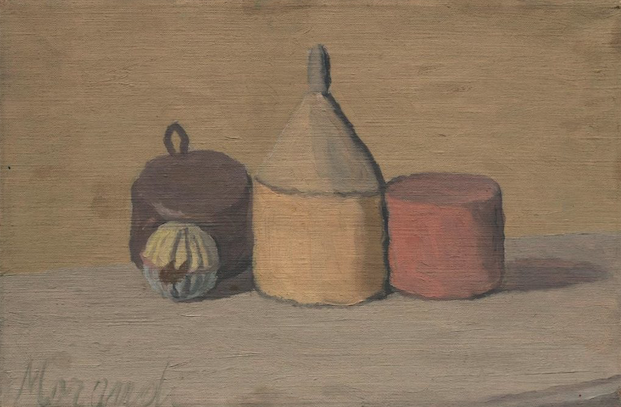
Morandi’s paintings, however, are different. More often than not they are described in terms of beauty and silence, and it is true that his combinations of everyday things, carefully lit and spaced, and enhanced by a limited colour range of mostly beiges, browns, blues, greyish yellows, and rusts, can create a mood of almost ineffable calm. They often seem like meditations. Unlike the images in Meyerowtz’s book, however, they’re almost always composed in groups, in relationships, and as Janet Abramovicz, for a while the artist’s assistant, once said, he lived so closely with his objects that they almost became neighbours, friends, and family.
In an unusual and interesting article, William Eaton has remarked that the placement and association of the objects in Morandi’s still-lifes seldom feel arbitrary; in the most compelling of them we sense that his choices and decisions are important, that his compositions are trying to tell us something, perhaps about how we relate to each other and how it feels to be a human being at a specific time in a particular situation. The paintings, almost certainly independently of the artist’s conscious intentions, seem to focus on two particular aspects of human relationships. The first is the space, physically minimal but psychologically expansive, between the ‘I’ and other people; the second is how we take up positions, poses, and play distinct roles in relation to those around us. Morandi, in his art and probably in his life, liked to create order, to reduce chaos and disarray, as well as to harmonise. Nevertheless, while Morandi may have been disciplined in his aesthetics, he was not especially austere; as his use of colour suggests, his vision was predominantly one of restraint and sensitivity. Nor was he particularly withdrawn or reticent, except with regard to the outside world, about which he was only intermittently curious. In his own domain he seems to have been active and outgoing, as well as secure; while he did not often venture far from the studio, it appears that he was usually welcoming and gracious to guests.
For further exploration
Joel Meyerowitz’ book, Morandi’s Objects: https://www.wallpaper.com/art/photography/joel-meyerowitz-interview-morandis-objects-book-review
William Eaton’s article: https://zeteojournal.com/2015/11/23/morandi-relationships-fascism-still-life-zeteo-eaton/
Image on index page: Morandi’s studio by Joel Meyerowitz
Current listening: https://www.youtube.com/watch?v=wgZEv6UpSos
Still life by Giorgio Morandi