As-Sirat
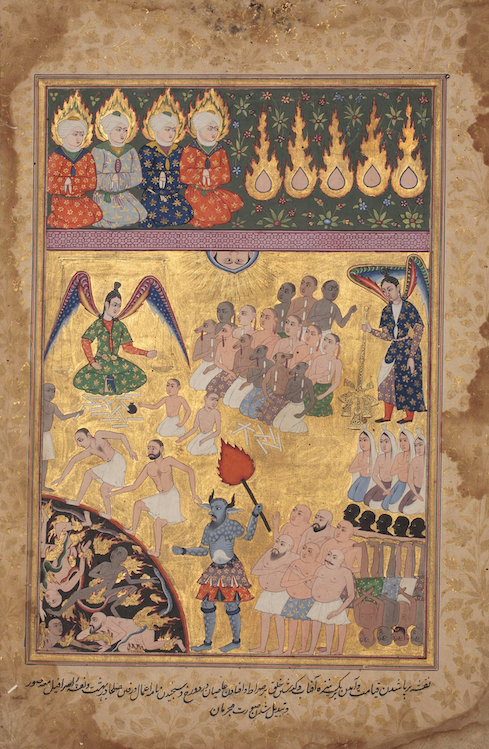
‘Sirat in the Afterlife’, Indian manuscript, 1610-1630
The countercultural film ‘Sirat’ (2025, Oliver Laxe), highly praised by some and dismissed by others, opens with a view of a wall of battered loudspeakers set in the Moroccan desert, dun-coloured cliffs behind them, which emit a deep and ferocious sound. It is soon followed by a scene of writhing, swirling, sunburnt ravers, many with tattoos, scars, braids, and studs, dancing in high euphoria. The middle-aged Luis, accompanied by his young son and dog, anxiously moves among them, handing out pictures of his daughter Mar, who disappeared some months ago; he has heard that she might be found there, but his search is in vain. A punkish woman and her friends, hardcore yet more forthcoming than most, tell Luis that another rave will soon be held somewhere far away, across the desert. Suddenly the army arrives and orders an evacuation; it appears that the country, and perhaps civilisation, is on the brink of a major war.
Luis and his son decide to follow this small group of ravers, who pack up rapidly and move on in their heavy-duty vehicles; their uninvited companions set out behind them in a small van. The journey is tough and unforgiving; before long, during a storm, a tragedy occurs, and the film shifts into a wild allegory, suggesting that even the most off-grid nomadic existence can be deconstructed, destroyed, and turned into chaos. The mood is raw, jagged, and threatening; the ravers’ daily routines of music, dancing, and drug-taking continue to be interrupted by intermittent radio broadcasts about the impending conflict. Catastrophe, perhaps inevitably, overtakes them, but not without occasional moments of warm solidarity and generous mutual support.
According to Laxe, ‘Sirat’ - despite its incessant pounding drama - compels introspection. As he explained in an interview, ‘There is so much pain inside us, and in the world we live in, that we distract ourselves all the time… In a way, the film is about wounded people, it’s about humanity. We are all broken; from both psychological and spiritual perspectives, we have broken hearts. Dancing is not selfish. You can be connected to the pain of the world and still celebrate life’. ‘When an era changes’, he added, ‘it’s not like a door - it’s a fade, and that’s why sometimes the past appears inside the future. This world is dying, and it will pass. Life will push us to the edge of the abyss, and we will be obliged to change. We’re all on the same train; all human beings are wounded’. In another conversation, asked about what we can do about the future, he replied: ‘What I hear from my masters is that we don’t have to do much. We just have to go to the countryside, to live, to listen, to whisper, to worship, to pray - and to wait for the system to shift. Everybody has to serve in their own way. One of the most powerful weapons is to love sincerely, to take care, to serve, to do everything as if it were an art form and do it with your heart. Everything is a sirat, a path’.
There are intentional analogies between the film and Islamic thought, and an early onscreen statement briefly notes that its title refers to the belief that when the dead have been resurrected and assembled on Judgement Day, they will cross Hell over the bridge of As-Sirat, which is narrower than a hair and sharper than a sword. Some will cross as fast as the blink of an eye, as lightning, the wind, or as swift horses; some will cross running, walking, or crawling; others will be snatched and thrown into the Fire, each according to his or her past deeds. The ability to cross it safely and quickly is directly proportional to a person’s steadfastness on the 'straight path' during their years on earth. As-Sirat is a metaphor for the soul’s journey; there are right and wrong ways to behave in this world, with serious consequences in the afterlife. The film’s interpretation of this idea is thoroughly pessimistic, and as the quest becomes a terrifying path to nowhere, it brings to mind the existential despair of Paul Bowles’ novel, The Sheltering Sky, also set (and later filmed by Bertolucci) in North Africa, with which it forms an interesting contrast.
According to the director, Sufism, of which he is an adherent, was an important source of inspiration. There are hints of this in the film; the rave in the desert is faintly evocative of the festivals of Sufi trance music played by the celebrated Moroccan Joujouka musicians, just as the ravers’ dancing may have been intended to recall the whirling dervishes of the ritual Sama (or Sema), but the echoes are distant. Sama is performed as part of the meditation and prayer practice known as Dhikr (‘remembrance’), which encourages the participant to reflect on the all-encompassing presence of God, known as Tawhid, and its origins are attributed to Jalal al-Din Rumi, Sufi master, poet, and founder of the Mevlevi Order. It is said that one day, while walking through a town marketplace, he heard the words La ilaha ilallah (‘There is no god but Allah’) in the rhythmic hammering of gold-beaters, which so entranced him with happiness that he stretched out both of his arms and started spinning in a circle; this was the birth of the whirling dances of the Mevlevi dervishes. Sama has come to represent the mystical journey of spiritual ascent; turning towards the truth, Sufi followers abandon their egos and arrive at perfection; after returning from those heights, they are better able to love and be of service to the whole of creation.
For further exploration:
‘Sirat’ trailer: https://www.youtube.com/watch?v=ww-IXHXvS70
And another: https://www.npr.org/2025/11/14/nx-s1-5608107/sirat-review
An interview: https://www.interviewmagazine.com/film/how-sirat-director-oliver-laxe-found-god-at-a-rave
And another: https://48hills.org/2026/02/sirat-director-oliver-laxe-cinema-can-penetrate-the-human-metabolism/
The dancing scene: https://www.youtube.com/watch?v=dU8xQwliwLA&list=RDWGwRvqME0rg&index=2
The Sheltering Sky: https://www.independent.co.uk/arts-entertainment/books/reviews/book-of-a-lifetime-the-sheltering-sky-by-paul-bowles-8053566.html
The Sama (or Sema): https://www.youtube.com/watch?v=hVHKPlAOAIA
The Joujouka festival: https://www.youtube.com/watch?v=ZnxP9uTyAQ8
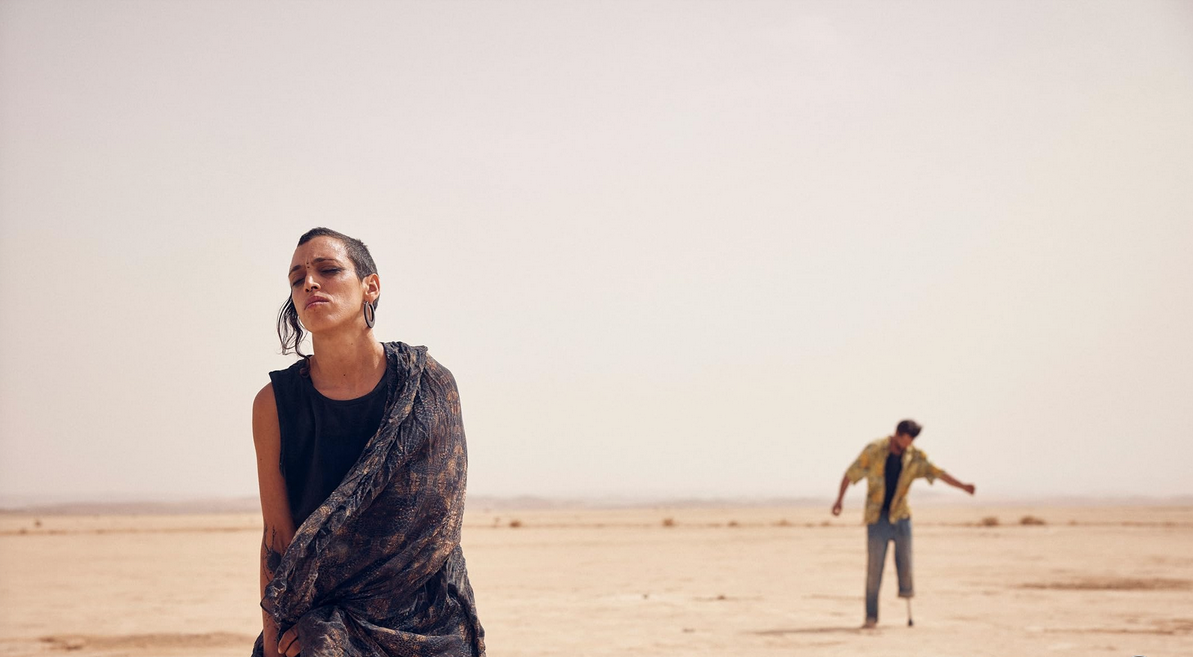
Still from ‘Sirat’