The Life You Want
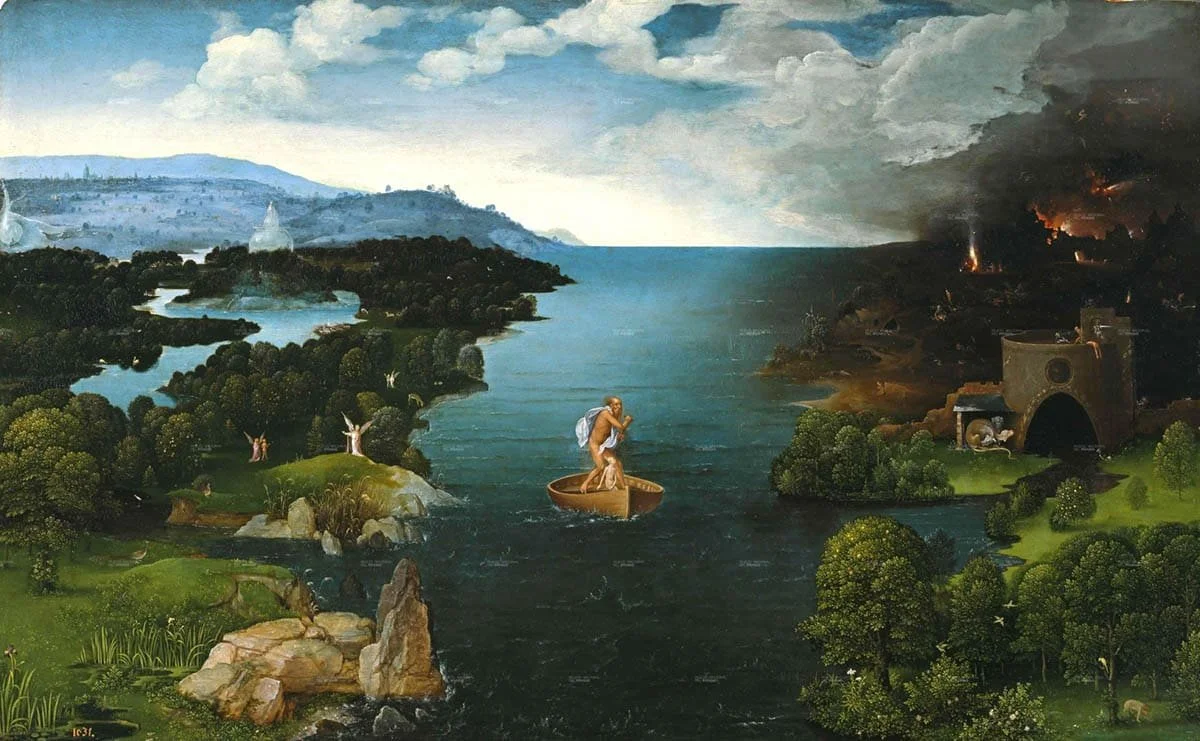
‘Charon crossing the Styx’, by Joachim Patinir, c 1520, Museo del Prado, Madrid. A detail of this painting is used on the cover of The Life You Want
Adam Phillips once came to Dublin to give a lecture at the gallery where I worked and subsequently wrote a piece for our Alice Neel catalogue; I have enjoyed his books for a long time. His writing, which in broad terms might be called psychoanalytic, is always thought-provoking, and in The Life You Want, a recent collection of engaging essays, he considers what we hope to get from our lives and how we envisage fulfilment. Suggesting that we usually come up with a complex mixture of ‘the all too familiar and the experimental, the mostly reassuring and the partly disinhibited’ when we think about such things, he proposes that when we were children our parents recognised some parts of us and not others, and as adults we both maintain and reject their appraisals, displaying and underplaying our encouraged aspects, hiding and flourishing those that were unacknowledged. He adds that it is only when we are frustrated that we can begin to be fully aware of our desires, and that from a Freudian perspective this may help us to move towards the ‘ordinary unhappiness’ of reality. At the same time, however, we should recognise the pleasures of longing itself. ‘Old-fashioned psychoanalysis always had a known destination, he drily remarks.
Phillips likes to undermine grand theories; he also enjoys deconstructing his own propositions and pretensions, frequently making counterintuitive and gently provocative pronouncements about both important and relatively insignificant subjects. For example, he once mused that much, and perhaps most, human endeavour — from art and prayer to political activity — might be seen as a form of attention-seeking. Similarly, in The Life You Want, Phillips’ contrarian tendencies lead him to reassess the idea of ‘resistance’, which, in psychoanalysis, refers to the conscious and unconscious strategies that patients may use to impede or derail the therapeutic process. He observes that the analysand might have perfectly good reasons for avoidance, thereby allowing resistance to prolong and enrich the analytic work. This is a frequent trope; he commonly approaches something apparently undesirable, such as guilt or anxiety, presenting it as a necessary or potentially transformative step on a developmental path. It is not always easy to grasp exactly what Phillips is saying, because he can be elusive and mercurial, but it is usually a pleasure to follow his thinking. His writing is often be a kind of dreamwork, bringing together contradictory elements into poetic and evocative forms.
After finishing The Life You Want, I began Paul Brunton’s A Search In Secret India, a book I’d been meaning to read for some time, and often described as a classic of its kind. It is an enjoyable account of another kind of quest for a fulfilled life, one that is in many ways a marked contrast to Phillips’ sophistication, but they are perhaps remotely connected through a shared interest in self-awareness. The author, born into a London East End family of immigrants from Eastern Europe, was an unusual man; a journalist and writer with various pseudonyms, he was also involved in a bookshop in Bloomsbury, London, and became familiar with the British literary and occult worlds of the 1920s. After the unexpected success of A Search in Ancient India, first published in 1934, he decided to make ‘Paul Brunton’ his permanent name.
In 1930, Brunton, then known as Hyman Raphael Hurst, travelled to India with the aim of spending time with yogis, mystics and gurus, in order to discover the life he wanted; he was determined to write about his experiences with candour and common sense. Many of the absorbing tales in A Search In Secret India, not dissimilar to those in Paramahansa Yogananda’s Autobiography of a Yogi, published about a decade later, stretch credibility, which suggests that either they were either truly impressive or that he had a tendency to embroider and exaggerate them. At the end of his long journey around India, he returned to the ashram near the holy mountain Arunachala, where he had earlier met Ramana Maharshi, a sage and teacher now widely admired and revered, and whom Brunton is credited with revealing to the West. One day, while sitting in his presence, Brunton had a life-changing experience, which he later vividly described. ‘I find myself outside the rim of world consciousness’, he wrote. ’The planet which has so far harboured me disappears. I am in the midst of an ocean of blazing light. The latter, I feel rather than think, is the primeval stuff out of which worlds are created, the first state of matter. It stretches away into untellable infinite space, incredibly alive’.
Such moments of ecstasy are not, however, especially associated with Ramana Maharshi, who talked sparingly and put great emphasis on what he called ‘self-enquiry’, which he believed to be the most efficient and direct way of discovering the unreality of the perception of the ‘I’, or personal identity. Loosely put, Ramana taught that the process requires sustained attention to ‘I’ thoughts, staying with them without rejection or attachment, and then to ask oneself to whom the thoughts have appeared. The answer, of course, is ‘to me’, and this invites further enquiry as to whether or not the ‘me’ is a separate and independent entity. It is soon discovered that the ‘I’ is only an aspect of limited consciousness. According to Ramana, this ongoing process of self-awareness leads to the disappearance of ‘I’ thoughts and their causes, and to eventual liberation or ‘self-realisation’.
Brunton became well-known, and his interest in metaphysical matters continued to deepen. Many years afterwards, in the 1940s and 1950s, he occasionally stayed as a guest with the parents of controversial American author and former psychoanalyst Jeffrey Masson, who published a critical book about him called My Father's Guru: A Journey Through Spirituality and Disillusion. Without reading the story it is difficult to know the reasons why Masson chose to do so, but some contemporaries have said that Brunton, if he was a guru at all, never formally accepted ‘disciples’, only called himself a ‘student’ of the subjects he wrote about, and that the book was clearly biased and distorted. In any event, as demonstrated in Adam Phillips’ essays, it appears that the road to the life we want is seldom straight and, besides, as Ramana Maharshi implied, it is unwise to accrue much personal authority or self-esteem along the way.
For further exploration:
The Life You Want reviewed in ‘The New Yorker’: https://www.newyorker.com/magazine/2026/03/23/the-life-you-want-adam-phillips-book-review
A Search in Secret India: https://www.theosophy.world/books/paul-brunton/search-secret-india-paul-brunton
Paul Brunton: https://www.paulbrunton.org/
Image on index page: a view of Arunachala, the sacred mountain
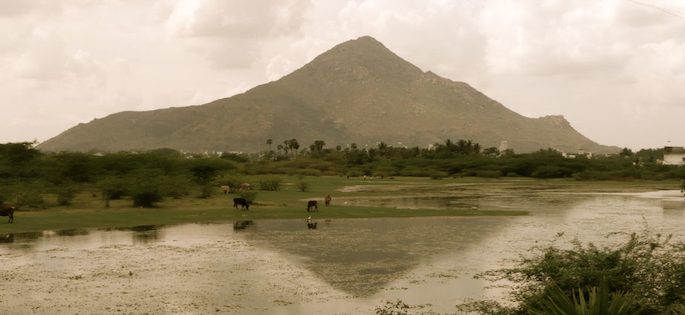
A view of Arunachala in South India