Leave No Trace
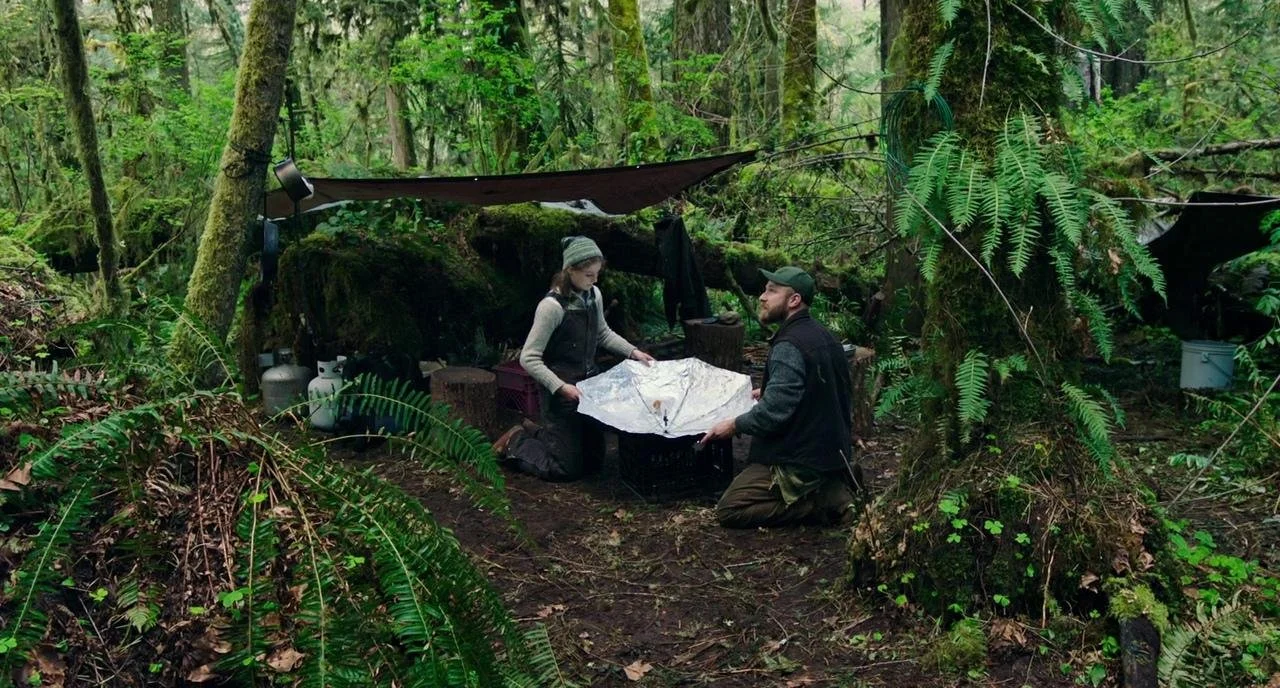
A still from ‘Leave No Trace’
Debra Granik’s 2018 film ‘Leave No Trace’, based on a novel that is itself founded on a true story, opens in a thick forest, apparently wild and raw, which turns out to be a public park near Portland, Oregon. In their informal camp, which looks cared-for and lived-in, Will, an army veteran, and his 13-year-old daughter Tom are seen chopping wood for their fire, playing chess, and gathering mushrooms. There is almost no dialogue, which gives the viewer an intimate sense of the their comfortable communication and togetherness. They follow routines, walking into town to buy groceries, with Will making some money by selling his prescription drugs to people living in tents on the outskirts of the city. Their life is hard, but the affection between them is palpable, and the two lead actors, Ben Foster and Thomasin McKenzie, are wholly convincing; it seems plausible that they have been living in the woods for months, and perhaps even years.
Their outsider’s world is fragile, however, and when a jogger sees Tom by chance, police come and raid their improvised home, bringing in Will and Tom for questioning. Tom is put into a detention centre for teenage girls, and Will is subjected to abundant psychological tests; the freedom of the forest is replaced by the confines of well-meaning but incompetent bureaucracy. Will’s unusual behaviour is approached with limited understanding and sensitivity, and the film makes this clear, but it also implies that it is right for society to be concerned about Tom’s education and absence from school. While Will continues to resist civilisation, even in the face of kindness, Tom is torn between her attraction to the world and attachment to her father; Will believes that as long as they are camping in the woods together, his PTSD problems can be kept at bay, but Tom is growing up. They are so close that their imminent separation is alarming; it isn’t obvious how they will survive it. The film evokes a curious mood, one that is both gloomy and hopeful, its sadness enlightened by moments of unexpected tenderness and generosity. There is much sympathy for the struggles of those who choose to opt out of society and prefer to be left alone because they can’t fit in to the world at large; in a bleak tale that is intermittently sweetened by the kindness of strangers, there is no bitterness in Tom’s growing realisation that what is wrong with her father isn’t wrong with her. It is all expressed with gentleness and understatement.
The ‘outsider’ is a mythic trope in modern American culture, exemplified by literary figures like Huckleberry Finn and Holden Caulfield, the protagonists in films such as ‘Rebel Without a Cause’ and ‘Easy Rider’, and more generally in movements such as the Beat generation of the 1950s and the Counterculture of the late 1960s. Typically, ‘outsiders’ withdraw from the constraints of conformity, refuse the comforts of middle-class life, live by their wits, and follow their feelings. Earlier, in the 19th century, the writings of the American Transcendentalists took a more reflective approach to similar ideas, emphasising trust in personal instincts and insights rather than societal norms, the belief that people are fundamentally good, and that nature is a benign source of inspiration. The movement’s key figures, Ralph Waldo Emerson, Walt Whitman, and Henry David Thoreau, became unexpectedly influential in the 1960s Counterculture.
‘Leave No Trace’ reminded me of these authors, some of whose books I bought in 1968 before I went up to university, mostly in new American editions, which were the only ones that were readily available. The exception was a old volume of Emerson’s essays, a small green hardback, found in one of Dublin’s bookshops, many of which, in those days, had good secondhand departments. I can’t find it now, and I suspect that I may have given it to a friend at university, but in searching for it I discovered another copy in my bookshelves, probably of much the same age, that had once been owned by my great-grandfather. The essay I most distinctly recall is ‘Self-Reliance’, first published in 1841, which dwells on the importance of individualism and self-expression, proposing that true genius arises from trusting oneself and embracing nonconformity.
Emerson suggests that in order to experience the oneness with nature for which we are naturally suited, we must be separate from the distractions imposed on us by society. He wrote: ‘To go into solitude, a man needs to retire as much from his chamber as from society. I am not solitary whilst I read and write, though nobody is with me. But if a man would be alone, let him look at the stars’. Society, he says, destroys wholeness, whereas ‘Nature, in its ministry to man, is not only the material, but is also the process and the result. All the parts incessantly work into each other's hands for the profit of man. The wind sows the seed; the sun evaporates the sea; the wind blows the vapour to the field; the ice, on the other side of the planet, condenses rain on this; the rain feeds the plant; the plant feeds the animal; and thus the endless circulations of the divine charity nourish man’. Emerson held that the divine was little different from nature, which he sometimes referred to as ‘Universal Being’, and it enables us to be and feel at one with our surroundings: ‘From the earth, as a shore, I look out into that silent sea; I seem to partake its rapid transformations: the active enchantment reaches my dust, and I dilate and conspire with the morning wind’. This is close to pantheism, but there was a difference: he also believed that the outward world is only an appearance, that it has no inherent substance. It is the manifestation of the spiritual world, the thoughts of God.
Thoreau’s Walden, also read at that time, had much influence on me; many years later, when I was a curator, it became the focus of a group show called ‘Huts’, on which I worked on with the artist Tal R. The book is the fruit of the two years and two months that Thoreau spent living on his own by Walden Pond (perhaps more accurately described as a lake), near Concord, Massachusetts. He built a small hut or cabin on land owned by his friend Emerson, grew his own vegetables and did odd jobs. He wanted to live simply, to contemplate, walk, write, and commune with nature. As he explained, ‘I went to the woods because I wished to live deliberately, to front only the essential facts of life’. A passage that struck me vividly then, and still resonates, concerns his conversations with visitors. ‘I have found it a singular luxury to talk across the pond to a companion on the other side. In my house we were so near that we could not begin to hear — we could not speak low enough to be heard; as when you throw two stones into calm water so near that they break each other’s undulations’. This is not an experience, unfortunately, that I have been able to emulate in my own life.
For further exploration:
Film trailer: https://www.youtube.com/watch?v=_07ktacEGo8
Review of ‘Leave No Trace’: https://www.theguardian.com/film/2018/jul/01/leave-no-trace-review-debra-granik-winters-bone
Emerson and ‘Self Reliance’: https://emersoncentral.com/texts/essays-first-series/self-reliance/
Thoreau and Walden: https://www.thoreau-online.org/walden.html
listening: https://www.youtube.com/watch?v=8KCCKnI38Lk
Image on index page: still from ‘Leave No Trace’
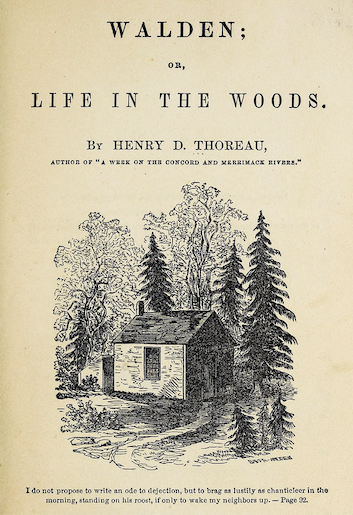
Frontispiece of the first edition of Walden