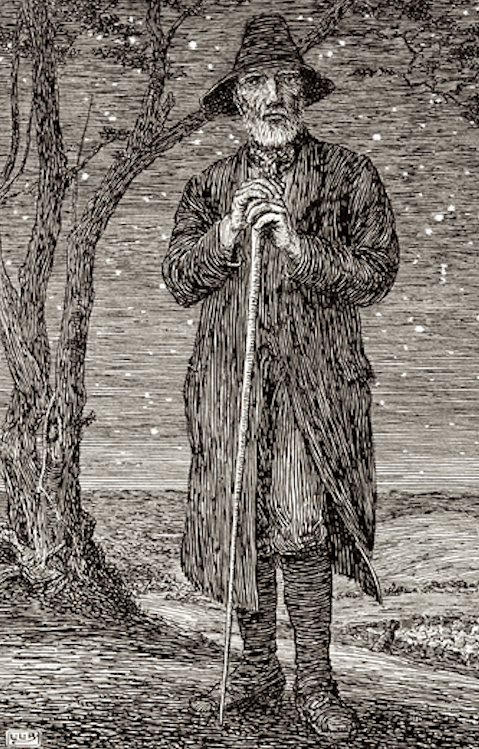
An image of Snarley Bob in ‘Mad Shepherds’
L.P. Jacks (1860–1955), an English minister, philosopher and writer, became interested in parapsychology and psychic research. Neither rejecting mediumistic evidence nor accepting it uncritically, he chose to wonder about how it might expand dominant beliefs and ideas: ‘We may find — I do not say positively that we shall — that the upshot of psychical research is not to give us another world, supplementary or successive to this one, or of another nature than this, but to extend the boundaries and deepen the significance of the one world in which we and the so-called ‘departed’ are all living together under a unitary system of law’.
His tolerance and curiosity are also evident in Mad Shepherds, a vivid account of motley characters on the fringes of early 20th century English rural society. First published in 1910 (and now reprinted with a new introduction by McKenzie Crook, who was responsible for the delightfully off-beat television series ‘Detectorists’ and ‘Small Prophets’) the book was written when he was living in a small village on Bredon Hill in the Cotswolds. It is affectionate and informal. The main characters, especially Robert Dellanow, known as Snarley Bob, a shepherd more at home with his sheep than with humans, are memorable; they are determinedly independent, wilful, and shrewd . The extraordinary care and attention he devoted to the individual qualities of his sheep ensured that Snarley Bob became an outstanding breeder, making his employer, the local farmer, rich and famous, but he had no interest in rewards other than heavenly acknowledgement of his efforts to become, in the Biblical sense, a ‘Good Shepherd’. He seems to have been something of a mystic; the book describes his communion with the stars, his intense delight in nightingales, and the manner in which he was translated into what might be called ‘altered states’ after consumption of alcohol. Towards the end of the narrative there are touching accounts of the death of his friend, Shepherd Toller, who became deranged, took to the hills and lived there on his own for a considerable length of time, stealing sheep and poultry, as well as of Snarley Bob’s own passing.
In the world’s religions there is a profusion of mad or eccentric people whose sayings and behaviour have become part of folklore, or who have been venerated by later generations who introduced them into their own spiritual lives as mentors and guides. Their apparent insanity is often said to be a cover or guise, a startling means of drawing in listeners, of conveying deep spiritual insights. In Russia there is an old tradition of yurodivy or ‘Fools for Christ’, men who give up worldly possessions and extravagantly flout society’s conventions. The Turkish Nasreddin Hoja, a medieval preacher, teacher, farmer, and trickster, frequently appears in Central Asian tales, and countless stories are told about him, satirical and funny; many have multiple layers of meaning and interpretation. In India, over centuries, there have been Tantric ascetics who lived in graveyards and enjoyed both intoxication and sexual activity, considering that they could be used as ways towards spiritual liberation.
Tibetan Buddhism, in particular, is known for its plentiful religious eccentrics and saintly madmen. Drukpa Kunley (1455-1529), for instance, was a monk, missionary, and poet in the Drukpa Kagyu lineage, and in a country where such people are usually revered, he was often drunk, composed bawdy songs, and seduced women. Well-known today in Tibet and Nepal, he is also a beloved figure in Bhutanese popular religion, his image and symbol, a phallus, being found in homes throughout the country. Again, it is often said that he was not actually mad or immoral, but an enlightened Buddhist master who deliberately chose transgression as a method of teaching.
Chögyam Trungpa (1939–1987) the eleventh Trungpa Tulku of the Kagyu lineage, was a Tibetan refugee who founded the Naropa Institute and the Shambhala Training programme in America. Notorious in Buddhist circles in the West, he led a colourful life, attracted a large number of students, wrote a handful of influential books, and became the subject of serious documented allegations about his personal life, especially with regard to his conduct with followers. Trungpa’s supporters claim he taught that every aspect of human existence, including passion, desire, anger, neurosis, and alcohol, were to be embraced, transmuted, or transformed. He liked to called this wild approach to spiritual freedom, which owed at least something to traditional Tibetan Vajrayana Buddhism, ‘Crazy Wisdom’, and he placed it in the context of the small but genuine lineage of respected aberrant Tibetan yogis, to which Drukpa Kunley belonged. His detractors, taking a more conventional view of his behaviour, thought otherwise. Even some of those who accepted his story about the ‘Crazy Wisdom’ lineage have pointed out that in the past such teachers only worked this way with a small number of students or followers, but Trungpa shared it with thousands.
Chögyam Trungpa died in 1987, at the age of 47, in Nova Scotia, Canada, where he had moved the international headquarters of the Vajradhatu Buddhist Church. Many people, including some of his most devoted students, believed that his death was related to, if not caused by, his extravagant lifestyle, and especially to his legendary drinking habit. His cremation was accompanied by extravagant funerary rites and senior members of his original order; from a Tibetan point of view he was not an ordinary man but a bodhisattva, an enlightened master who had vowed to take rebirth in order to help liberate sentient beings. Because of this, all his actions, no matter how problematic they may have seemed to ordinary people, were to be understood as selfless teachings. In that light, his parinirvana is still celebrated in some monasteries in his native country.
For further exploration:
The new edition of Mad Shepherds: https://www.littletoller.co.uk/shop/books/little-toller/mad-shepherds-by-l-p-jacks/
On Drukpa Kunley: https://foundbht.com/blog/post/drukpa-kunley-the-divine-madman
On Chögyam Trungpa: https://e-buddhism.com/chogyam-trungpa/
Image on index page: an early 20th century English shepherd
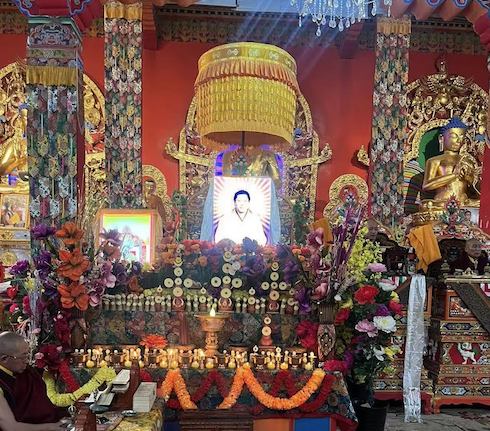
A Tibetan celebration of Chögyam Trungpa’s paranirvana