Marsden Hartley, Der Blaue Reiter, and reverse glass painting
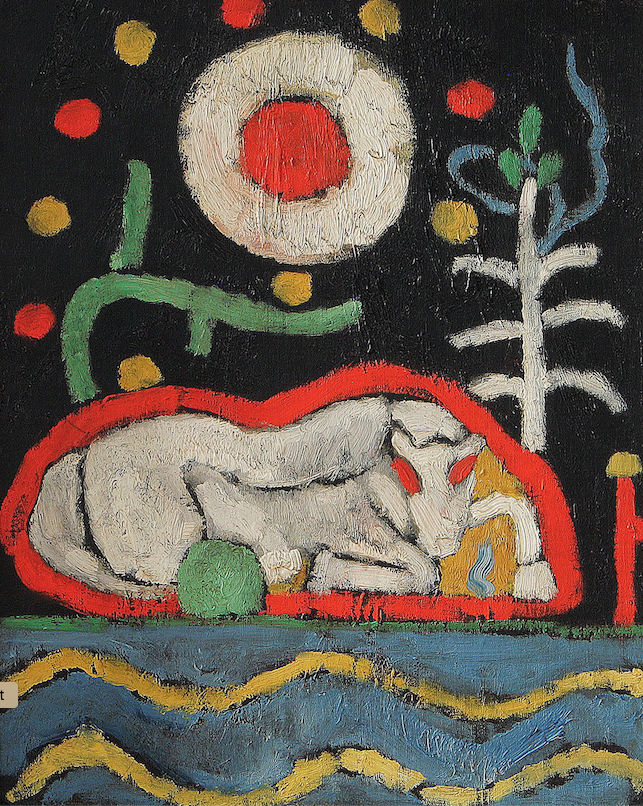
Berlin Series No.2, by Marsden Hartley, 1914
Painters frequently make unusually interesting observations about art, perhaps because they look more intently than the rest of us and tend to comment intuitively rather than just using the intellect. It was Mamma Andersson and Tal R, in their short video talks for the Louisiana Museum in Denmark, who convinced me to pay renewed attention to Marsden Hartley, the early 20th century American artist, the former speaking of Hartley’s uncompromising oddness and darkness, suggesting that in many ways his work could be regarded as spiritual, the latter musing that for most painters, including Hartley, the overt subject of their art is a kind of ‘alibi’. Much good work is ‘weak’, he added, because it is often most engaging when its maker is ‘lost’. Hartley has also been described as ‘restless’, largely because of his peripatetic life and frequent shifts in style, but the changes and experimentation that are typical of his paintings are underpinned with a kind of constancy, a sense of deep unease and anxiety, which distinguishes his work from that of most of his peers. His agitation may have been partially due to the loneliness and isolation that marked his childhood, but it must also have been difficult to live as a gay man in the society of his day, even if it was unremarkable in the bohemian artistic circles in which he moved.
In 1912, Hartley went from New York to Paris, where he came to know Gertrude Stein, Pablo Picasso, and Robert Delaunay; then, after moving to Germany, he befriended Franz Marc, Wassily Kandinsky, and other members of ‘Der Blaue Reiter’, the group of artists who were interested in the expressive potential of colour, as well as the emotional and spiritual aspects of painting. They organised two exhibitions in Munich and put together an ‘almanac’ that included their own work as well as art from different times and cultures; antique reliefs were juxtaposed with children's sketches, Eastern art with medieval wood carvings. There were also images of old ‘reverse glass’ paintings, drawn from the private collections of their immediate circle.
The elaborate technique of reverse glass painting, known in Europe since the middle ages, had developed into a vernacular form over the course of three centuries, particularly in Southern Germany, Austria, and other countries in the area. Mainly devoted to religious subjects, the paintings were produced quickly and cheaply; they were carried, often by peddlers with back-baskets, throughout the countries of the Habsburg Monarchy. Sold at fairs, shrines and markets, they became popular and ubiquitous in modest households, both in towns and the countryside. The paintings, coarse, sometimes kitsch, but charming, typically use only a few striking colours and are handled with forceful simplicity.
It was probably at the Auer Dult, a traditional fair in Munich, that the artist Gabriele Münter, Kandinsky’s partner, first discovered them. She subsequently learnt the technique from Heinrich Rambold, a local painter who worked in that style, and soon introduced Kandinsky to the medium. Although he struggled at first, Kandinsky’s skill quickly developed, his glass paintings becoming multi-layered and inventive; sometimes he added to them modern materials such as glossy paper and aluminium foil, which were not commonly found in folk pictures. Between 1909 and 1918, Kandinsky created about fifty glass paintings and showed three at the first ‘Blaue Reiter’ exhibition; they were predominantly his own compositions, with occasional variations of traditional religious subjects. Some of the folk pictures, especially from the Oberammergau area, had hand-painted frames; influenced by their example, Münter and Kandinsky liked to decorate their own.
Marsden Hartley owned several reverse glass paintings, and in 1917, after returning to America, he painted about a dozen more. His interest was predictably short-lived: within a year he had moved on, but probably not before inspiring Rebecca Salsbury James, a self-taught painter, to take up the medium. James had been born in London to American parents who were traveling with the Buffalo Bill Wild West Show; she was raised and then settled in New York, where she married the photographer Paul Strand, but following their divorce she moved to Taos, New Mexico, where, influenced by Georgia O’Keeffe, she became known for paintings of flowers and still lifes, mostly on glass. This was unusual; by the end of World War II, the art of reverse glass painting had more or less been abandoned, apart from the copies of old images that were still being made and sold in Germany and neighbouring countries. Besides the Blaue Reiter group and Paul Klee, the technique was never really taken up by avant-garde or mainstream art; Dora Carrington’s glass paintings from the 1920s, and those of the current German artist Andrea Büttner, whose conceptual art has made use of the medium, are among the few exceptions.
For further exploration:
Marsden Hartley at the Louisiana: https://www.youtube.com/watch?v=oPDeWJLxqQE
Mamma Andersson on Marsden Hartley: https://channel.louisiana.dk/video/mamma-andersson-on-marsden-hartley
Tal R on Marsden Hartley: https://channel.louisiana.dk/video/tal-r-on-marsden-hartley
The Blaue Reiter and reverse glass painting: https://artsandculture.google.com/story/ggURzGrsnyEKdQ
The Blaue Reiter almanac: https://artsandculture.google.com/story/0137/IwXx1U48aQsVOQ
Some old reverse glass paintings: https://www.oberammergaumuseum.de/en/exhibitions/archive/reverse-glass-paintings-welten-hinter-glas
Marsden Hartley glass paintings: https://web.colby.edu/thelantern/2017/11/03/marsden-hartleys-glass-paintings/
Rebecca Salsbury James: https://salon94.com/artists/rebecca-salsbury-james
Image on index page: a painting on glass by Wassily Kandinsky (All Saints II. 1911. Lenbachhaus Gallery)
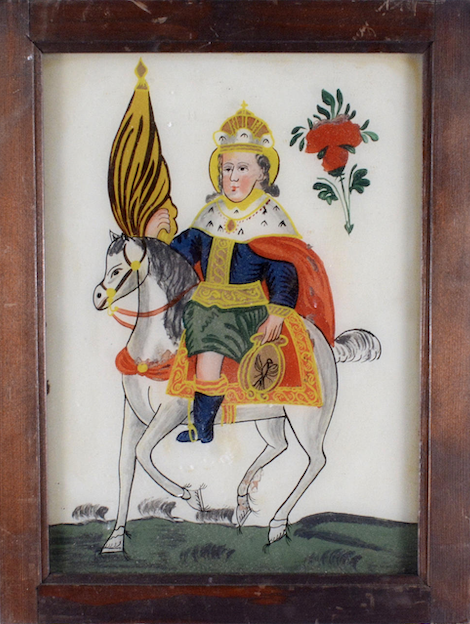
19th century reverse glass painting of St. Wenceslas; probably Bohemian