Crow and Dead Papa Toothwort
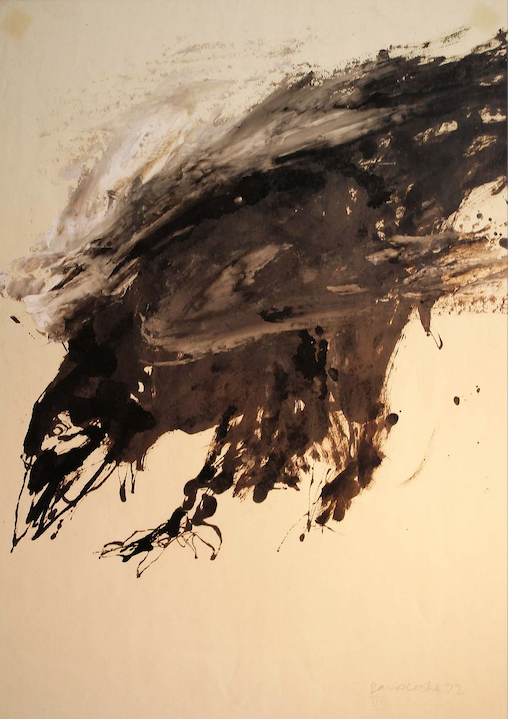
‘Crow’ by Barrie Cooke
In Max Porter’s celebrated first novel, Grief is the Thing with Feathers, the father of two young boys is writing a book on the poet Ted Hughes and trying to come to terms with the death of his wife. Crow, the ‘thing with feathers’ inspired by Hughes’ poems, appears in their house as a preternatural presence, forcing and enabling understanding. Shifting between the points of view of the father, the boys, and Crow itself, the novel is arranged in three sections, each with its own character and forms of expression. From mockery, abuse, and distress, the narrative moves to resolution and a kind of benediction; scattering his wife’s ashes, the father recognises in the boys’ voices a reflection of the life and spirit of their mother. In conjunction with its everyday language and elements of magic realism, Porter’s novel makes passing references to children’s fiction, nursery rhymes, and folk legends; a sense of transformation is effected by a rich blend of the ordinary, the imagined, and the reflexive. It is an impressive achievement.
Max Porter’s engaging second book, Lanny, focuses on another trauma, this time involving the fate of an unusual and gifted child. Like Grief Is the Thing With Feathers, the novel is both a contemporary story and a fable; inventive and intense, it is also sparse and extravagant. Like Crow, the perplexing figure of Dead Papa Toothwort provides its dominant energy; a kind of genius loci, Green Man, or protective spirit, he has an unrestrained and forceful personality, chatting, dozing, and feeding on the life of the country village in which the tale is set. Belonging to the English family of Pucks, wood sprites and river gods, he is named after one of the most peculiar species of native wildflowers; the common toothwort is parasitic and grows on tree roots, feeding on other plants because it has no chlorophyll of its own. Through Dead Papa Toothwort, we overhear smatterings of local talk and gobbets of conversation about everyday trivia; visually, these fragments wind in italics across the book’s pages, the boundaries between one element and another becoming enmeshed and indistinct. Relishing and thriving on the odds and ends of people’s lives, Dead Papa Toothwort, like Crow, is garrulous, pottering, and intimate, while also being a menacing and powerful trickster.
The incident at the heart of Lanny brings out the worst in the village; intolerance and suspicion, as well as spite and smugness, come to the surface, and there is s rush to condemn and judge people who are not much liked. The artist, the most open and imaginative person in the community, someone who has chosen to live a little differently, becomes a scapegoat; it is not coincidental that Porter tells stories that link contemporary crises with currents of ageless feeling and experience, and with ancient myths.
Asked in an interview about his influences and literary interests, Porter surprisingly chose as his favourite book In Parenthesis, an epic poem by David Jones, the Welsh poet and artist who flourished in the first half of the 20th century. Based on Jones’s own experiences as an infantryman in the British army, In Parenthesis, written in a mixture of lyrical verse and prose that combines formality, colloquial conversation, and slang, accounts for eight months of the Great War, from December 1915 to July 1916. ‘It is my ultimate companion and will never bore or exhaust me, or fully make sense to me’, Porter said, adding that it is ‘a mythic, dense, esoteric, funny, and heartbreaking modernist masterpiece, the pinnacle of 20th-century British poetry’.
Despite his dense and allusive style, Jones always emphasised that he was not deliberately trying to be experimental, suggesting that the similarity of his writing to the fragmentation and self-consciousness of the work of modernist contemporaries such as T.S.Eliot and W.H.Auden was due to the shared 'civilisational situation’ that arose in the wake of the traumatic experiences of World War I. Jones was convinced that it was the modern artist’s task to restore and renew the contemporary cultural ‘wasteland’, as well as to nurture our innate desire to turn the practical and ordinary into something beautiful; this, he believed, would attest to our inherent spirituality. Athough it is clear why Porter might be drawn to In Parenthesis, he may not fully share that ideal; both Grief is the Thing with Feathers and Lanny, while undoubtedly compassionate and sincere, are perhaps more attentive to innovation and cleverness for their own sakes.
For further exploration:
On Lanny: https://theadroitjournal.org/2019/09/18/a-post-brexit-folktale-a-review-of-lanny-by-max-porter/
Interview with Max Porter: https://slman.com/culture/max-porter
On In Parenthesis: https://thecityoflostbooks.glasgow.ac.uk/david-jones-in-parenthesis-1937-a-kind-of-space-between/
David Jones: https://apollo-magazine.com/how-david-jones-resisted-the-modern-world/
Image on index page: detail of the original endpiece for In Parenthesis by David Jones
Current listening: https://www.youtube.com/watch?v=k1KxthvX1Ms
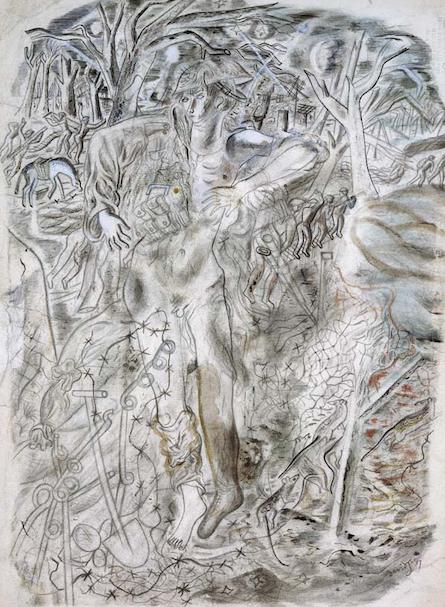
David Jones’ original frontispiece for In Parenthesis