Jumbo, Wantee, and the Merz Barn
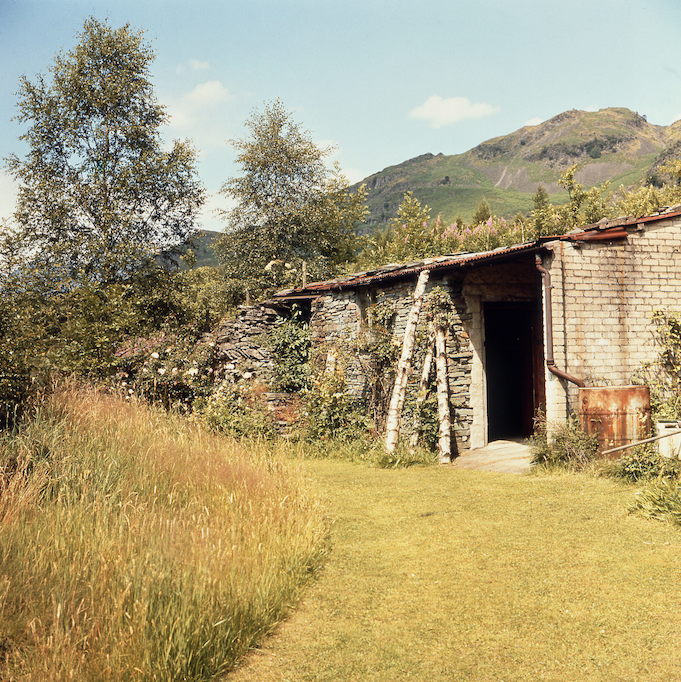
The Elterwater Merz Barn in the 1950s, falling into disrepaiur
During World War 1, Richard Hülsenbeck, a writer, poet, and psychoanalyst, was invalided out of the German army and went to live in Zürich, where he became involved with the Dadaist Cabaret Voltaire, which was set up for political and artistic purposes. The following year he moved back to Germany, bringing with him the ideas that he used to help found the Berlin Dada group. 'To make literature with a gun in my hand had for a time been my dream’, he wrote in 1920. He had a forceful and unyielding personality; I once went to a small but packed lecture he gave in the early 1970s in Dublin, where I asked how he managed to integrate his psychoanalytic practice, which is usually intended to help people to come to terms with the expectations and values of society, and his Dada strategies, which were designed to disrupt them. Hülsenbeck said that he didn’t understand the question.
In 1916, while George Grosz and John Heartfield were using collage to satirise the Berlin bourgeoisie and the rise of the far right, the German artist Kurt Schwitters was experimenting with Cubism and Expressionism. Two years later he began to make his own collages, soon afterwards inventing the term Merz, which he applied to all his creative activities, including poetry and performances, the name having been taken from a cut-up advertisement for the Kommerz bank. Schwitters asked to join the Berlin Dada group in late 1918 or early 1919, and according to Raoul Hausmann, one of its members, Richard Hülsenbeck rejected his application because of Schwitters's links to Der Sturm and Expressionism in general, which he and other Dadaists considered to be excessively Romantic and obsessed with aesthetics. Ridiculed by Hülsenbeck as 'the Caspar David Friedrich of the Dadaist Revolution’, Schwitters began his first Merzbau, a kind of grotto made from found materials, which gradually took over his home. Instigated by the death of a son and called ‘The Cathedral of Erotic Misery’, it was destroyed in 1943, during an air raid on Hanover.
After Hitler's rise to power in 1933, the Nazis were determined to eradicate what they regarded as Entartete Kunst, or degenerate art. Schwitters's work, among that of many others, was mocked, confiscated and eventually banned, and in January, 1937, hearing that he was of interest to the Gestapo, he hurriedly left for Norway, where his son, Ernst, was already living; Helma, his wife, stayed in Hanover to look after their parents. A few months after his escape, Hitler was photographed in front of one of Schwitters’ collages at an exhibition of ‘degenerate art’ in Munich. In Norway he began work on a second Merzbau, but when the Nazis invaded, he once again left in a rush, travelling to Edinburgh on the last ship out of the country. It is said that when he landed he had nothing with him but two white mice and a whittled birchwood sculpture. In Britain, however, regarded as an enemy alien, he was sent to various camps and finally interned in Douglas, on the Isle of Man, where he remained until November, 1941.
In her recent book, the curious and affectionate Looking for Mr.Schwitters, Jennifer Potter takes up the story and describes in detail the artist’s life in England, particularly the time he spent in the Lake District. The book is in part an account of her longstanding interest in him; she writes, for instance, about how, when she was a small girl, her family lived on a hill in Ambleside in Cumbria, from where you could look down at the boarding house on Gale Terrace in which he took lodgings in the summer of 1945. Schwitters was accompanied by Edith Thomas, a young woman half his age, whom he called ‘Wantee’ (apparently because she was always asking him if he wanted tea), and in turn he was known to her as ‘Jumbo’. They had met in the London house where they both boarded, and after the end of the war they decided to go to the Lake District for a holiday, paid for by the sale of the artist’s stamp collection. Wantee worked at the telephone switchboard in Marks & Spencer and knew nothing of avant-garde art, but she loved Schwitters and believed in him, so when it became clear that he liked Ambleside and wanted to live and work there, she decided to stay. In this new environment Schwitters earned an modest living by painting landscapes and portraits, which were well-meaning and sincere, but not very distinguished.
Then he had a stroke of good luck. A landscape architect, Harry Pierce, lived nearby at Cylinders Farm in Elterwater, where he was planting a hillside garden on the site of an old gunpowder works, and Schwitters, who had been commissioned to paint his portrait, was much taken with his approach: ‘he lets the weeds grow but makes it into a composition merely by adding some small touches, exactly like I make art from rubbish’. He asked if there might be a barn or shed on the land in which he could work, and Pierce offered him one. Before long, Schwitters received some more good news: he had been awarded a grant by the Museum of Modern Art in New York, and this would fund the sculpture he wanted to create in Pierce's stone building. The project would take a number of years to complete, but he was convinced it would be worth the effort, believing it would one day be considered a ‘Lakeland monument’. That autumn he began work with great energy and enthusiasm but was only able to spend three months on the final Merzbau; he became ill and died in January, 1948, aged only 60. A letter informing him that his application for British citizenship had been successful arrived two days after his death.
Today the Merzbau is empty. The only sculpted wall was transferred to Newcastle University’s Hatton Gallery years ago, but although the context is completely different, it continues to have a surprising impact on many viewers. One commentator has remerked that it is still possible to see how Schwitters allowed the contours of the stone to influence the wall’s shapes, with their subtle contrasts of colours and textures, and that the found objects settled in its hollows - a spout of a child's watering can, a three-pronged slate splitter, a length of brown string, a china egg - were both odd and poignant. Another has said that ‘what strikes me most of all… is its overriding hopefulness. In its nooks and crannies, I grant you, there is a feeling of death, of bomb sites and memorial places. But when you stand back, it seems airy and weightless, more of a wave than a wall. Its trajectory is upwards and to the right – towards what would have been, when it was in the barn, a tiny window… his final work, for all that it is only a fragment, seems always to be moving effortlessly towards the light’. Others have added that while Schwitters was a master of the incomplete, the fragment, and the flawed, he was also an advocate of harmony, of integration, of wholeness, quoting his statement that ‘Merz creates connections between absolutely everything in the world’.
The Elterwater Merz barn, although it now exists predominantly as an idea, is greatly cherished by many people. It is not obvious what should be done with the building. To restore it and replace the wall, either with the original or a facsimile, would be an act of belief and good will, but it might not be the right thing to do. Perhaps the most inspiring aspect of the work, both in its original and current states, is that immaterial sense of hopefulness, a quality which may be most effectively sustained if Schwitters’ last Merzbau is allowed to return to being a hay barn or potting-shed, living on as a faint reminder of his exile and yearning.
For further exploration:
https://merzbarnlangdale.wordpress.com/the-merzbarn/
https://www.frieze.com/article/house-dada-built
Photograph on index page: Schwitters (third from the right), Edith Thomas (second from the left) and friends at Cylinders Farm
Listening: https://www.youtube.com/watch?v=Tmtq1V3M7WQ
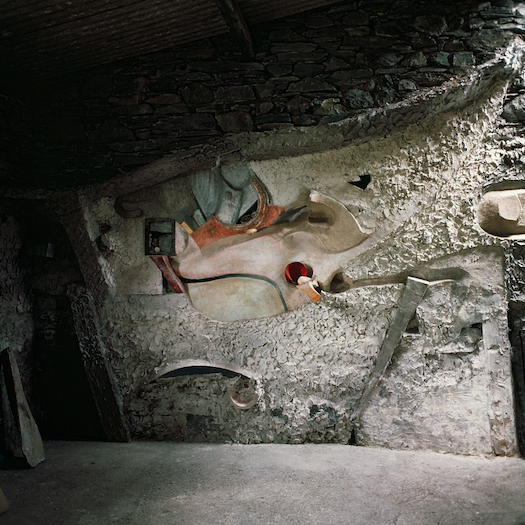
The wall in the Merz Barn before it was moved