Now we rise and we are everywhere
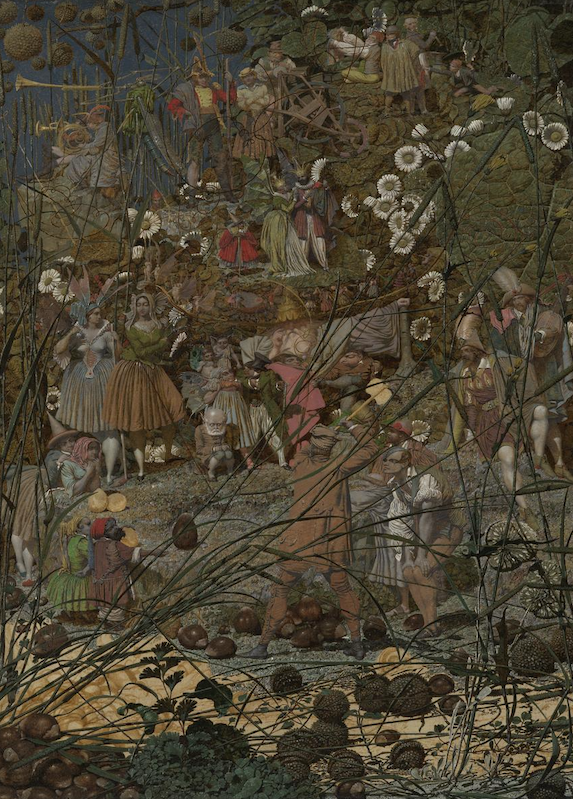
Richard Dadd, ‘The Fairy Feller’s Master-Stroke’, courtesy Tate, London
Richard Dadd’s most celebrated picture - perhaps his only well-known painting - is ‘The Fairy Feller’s Master-Stroke’, which he developed slowly over a period of years. Obscured by tall grasses and surrounded by huge daisies, fairy folk gather to watch one of them raise his axe to ‘fell’ a horse chestnut, which will be used to construct their queen’s new carriage. The figures were drawn entirely from the artist’s imagination, and some of them are very odd; strange disruptions of scale and lack of perspective add to the hallucinogenic mood. Reminiscent of Pre-Raphaelite realism and, at least to me, the humorous Gothic fantasy of Mervyn Peake’s ‘Gormenghast’, the picture straddles a fine line between the visionary and the foolish. It was painted for H.G.Haydon, an official at Bethlem hospital, where the artist was sent after becoming mentally ill.
Dadd began his training at London’s Royal Academy Schools in 1837, and only a few years later he was praised for his fanciful scenes of fairy life, but the paintings he made after the onset of insanity in 1843, including ‘The Fairy Feller’s Master-Stroke’, are his most memorable and distinctive achievements. They are at the heart of ‘Richard Dadd: Beyond Bedlam’, at the Royal Academy, the recent and most substantial show of Dadd’s work since the 1974 exhibition at the Tate Gallery, which was the first to attract the general public’s attention; before then Dadd’s work was known only by a small number of admirers, among them the war poet Siegfried Sassoon, who presented ‘The Fairy Feller’s Master-Stroke’ to the gallery.
Dadd’s descent into insanity, judged to be incurable, happened after a challenging expedition to the Middle East, where he travelled with Sir Thomas Phillips as his draughtsman. Hitherto considered to be intelligent, sensitive and mild-mannered, Dadd returned to his family troubled and delusional; his predicament worsened when, prompted by hallucinations, he murdered his father, whom he believed to be the devil. Taking to his heels, he fled to Paris and tried to kill a stranger on the way there. He was quickly caught, incarcerated, and then sent back to England, where he was committed, without trial, to Bethlem Hospital in south London. Twenty years later, in 1864, Dadd was moved to the new Broadmoor Asylum in Berkshire, where he remained until his death in 1886. Both institutions allowed him to continue his painting.
Within the confines of Bethlem, Dadd portrayed the world with different eyes; abandoning his earlier and more conventional style, he sometimes painted with extraordinary intensity, as in ‘Bacchanalian Scene’, in which peculiar faces can be seen through a mass of vegetation. When he was moved to Broadmoor his pictures changed again but their mood remained offbeat. His figures never seem to interact; they don’t talk or even look at one another, and it is not hard to see in these pictures a reflection of his own personality, which had become withdrawn and detached. Dadd’s work is often disturbing, all the more so because its weirdness emerges unobtrusively and unpredictably from what is otherwise unexceptional Victorian painting.
In September, 1974, not long before he died, the musician Nick Drake, who was also struggling with mental illness, read an article about Dadd and the Tate exhibition in the ‘Sunday Times Magazine’. He found it upsetting. The story of Dadd’s change of personality at the age of 24, when his open and engaging manner was replaced by erratic and hostile behaviour, as well as a tendency to avoid friends and companions, felt threatening. Besides, the article went on, in the wake of his crime and the diagnosis of madness, it seemed to many contemporaries that Dadd’s artistic career would soon come to an end because he was likely to spend most of the rest of his life in mental hospitals. The parallels were close enough to be distressing.
All this is explained in Nick Drake - The Life, the thorough and discreet authorised biography by Richard Morton Jack. A long book that contains little that is new and nothing that is controversial, it is nonetheless tactfully revealing. For instance, although he was often described, from school onwards, as reticent and somewhat passive, it is helpful to read details about his determined streak of professional ambition. He left Cambridge university before graduation in order to pursue a musical career, and his eventual producer, Joe Boyd, and sound engineer, John Wood, have both remarked on how unobtrusively forceful he was, quietly insisting that his records should be made exactly as he wished, and that his songs should be represented just as he had imagined them. His air of self-effacement, in some ways typical of his upbringing and education, may have been more a matter of manners than humility; Drake knew he was talented and had often been told so, but he appears to have expected the records to sell simply on the strength of their quality. His eventual disappointment at their lack of success turned inwards and festered.
Drake’s depression may have been exacerbated by his habitual use of marijuana, but Richard Morton Jack emphasises that Drake didn’t smoke as much as has often been assumed, and that there is no evidence that he took LSD or harder drugs. Nor does he trace his troubles to difficult relationships with his parents or unhappy experiences at school; he suggests that they were predominantly the result of mental illness, which robbed him of happiness, self-confidence, and creativity. His ability to compose new songs, which had flourished in the preceding three or four years, dwindled away; by the end of his life, only in his mid-twenties, he couldn’t sing and play the guitar at the same time, nor write lyrics. The account of his decline also tells of how he tried desperately to recapture his old spirit.
One of the main differences between this biography and its predecessors is that Richard Morton Jack had the support and approval of Drake’s sister Gabrielle, allowing him access to their father’s diary about Nick’s illness, from which he drew liberally. The last third of the book makes for gruelling reading, and in that context, as the author has explained, he came to believe that a tragic outcome may have been inevitable. Drake had reached the point where he couldn’t foresee a bearable future, and even though it would have pleased him if his records had sold better, it is unlikely that success would have would have helped him recover his creativity. It has often been suggested, or possibly hoped, that his death was not deliberate, but here it is made clear that the number of pills Drake swallowed was far in excess of an accidental overdose.
Today Nick Drake’s music is widely popular; during his short life, his three records barely sold at all. This was partly due to his reluctance to do interviews and a dislike of touring, but there were other reasons too. Most of my friends in the late 1960s and early 1970s were actively interested in contemporary music and bought LPs, as they were then called, but I only knew one couple who owned Drake’s first record, ‘Five Leaves Left’. I listened to and enjoyed it with them, but it was only decades later that I came to cherish his music as much as I do now. I find this surprising. Drake’s sensibility was not so different from my own, and as I reflected on the biography, I realised that the people he knew at school and at university moved in the same kind of social circles as I did. It may be that my early lack of engagement with his music, like that of most of our generation, was due to its deep melancholy, rooted in a profound sense of transience and impermanence, which was unusual and unfashionable at the time.
Not long after his death, the family had a line from the last song on his last album inscribed on the back of his headstone in the churchyard near their home at Tanworth-in-Arden. It reads ‘now we rise and we are everywhere’, an enigmatic and perhaps mystical phrase, but one that has more ordinary significance too. His mother, Molly, once remarked that it had been a great comfort when, over the years, so many young people wrote to tell her that Nick’s music had supported them through dark and trying periods of their own lives. ‘This is what he would have liked’, she explained. ‘That is why he said to me, ‘I’ve failed in every single thing I’ve tried to do - because he thought he hadn’t been able to help anyone and get through to them. But he has, and I hope he knows’.
For further exploration:
Richard Dadd exhibition review: https://www.theguardian.com/artanddesign/2026/jul/21/richard-dadd-review-royal-academy-london-beyond-bedlam
Nick Drake: the Life review: https://www.theguardian.com/books/2023/jun/07/nick-drake-by-richard-morton-jack-review-genius-remembered
A sensitive documentary about Nick Drake: https://www.youtube.com/watch?v=i6pZWHsbP3U
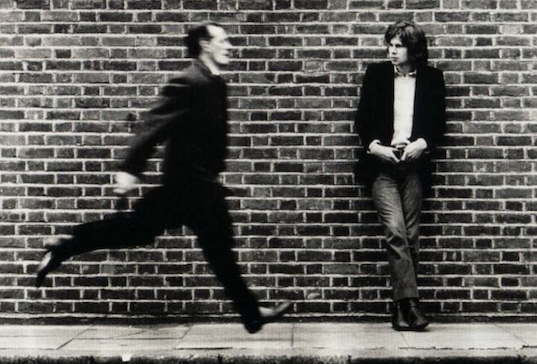
Nick Drake by Keith Morris, from the cover of ‘Five Leaves left’. The image on the index page is also by Keith Morris.